AI for Roofing Companies in 2026: The Complete Owner's Guide
Roofing is the trade where speed decides the job. The first credible bid after a hailstorm usually wins, and the crew that answers the phone at 8pm books the tarp. Here is exactly where AI helps a roofing company in 2026 — intake, measurement, estimating, dispatch, supplements and collections — what it costs, where it must stay out of the way, and a 30-day rollout that survives storm season.
By ContractorPro Editorial Team
Why roofing rewards AI more than almost any trade
Roofing has a demand pattern no other trade shares: long flat stretches punctuated by storm surges where a year's leads arrive in ten days. During those ten days the constraint is never crews first — it is the office. Calls stack up, inspections get double-booked, measurements sit in someone's truck, and bids go out on Thursday for a homeowner who signed with a competitor on Tuesday.
Everything about that bottleneck is text, phone and paperwork. That is precisely what current AI does well. It will not walk a 10/12 pitch, judge decking rot, or decide whether ice-and-water shield belongs three feet up or six. It will answer 40 calls simultaneously at 9pm, pull measurements from imagery, assemble a proposal from your pricebook, and follow up eleven times without getting tired of it.
The honest framing for an owner: AI is an office crew and a sales assistant that never sleeps. Judge it on the same numbers you would judge a hire — calls answered, inspections booked, bids sent within 24 hours, supplement dollars recovered, days-to-payment, and the hours you personally spend on admin.
In roofing the first credible bid usually wins. AI's job is to make sure that bid is always yours.
Workflow 1: Answer every storm call and book the inspection
The average roofing company misses a fifth to a third of inbound calls in normal weeks, and far more during a hail event, when the phone rings faster than anyone can pick up. In roofing a missed call is rarely a voicemail — it is a homeowner with an active leak dialing the next name on the list.
An AI receptionist answers on the first ring, on every simultaneous line. It asks the questions your best office person asks: address, age of roof, visible damage, active leak or not, insurance claim filed or not, single-family or commercial. It separates a tarp emergency from a replacement quote, books the inspection into the live calendar against real crew availability and drive time, and escalates true emergencies to a human phone immediately.
- Triage rules you define: active leak, storm damage assessment, routine replacement quote, repair, or out of service area.
- Simultaneous call handling — a hail surge does not queue behind one receptionist.
- Insurance questions captured up front: carrier, claim number, adjuster scheduled or not.
- Written transcript and summary on the customer record, so the inspector arrives already briefed.
- After-hours behavior you control: book it, escalate it, or capture and confirm at 7am.
Recover four missed calls a month at a $14,000 average replacement ticket and intake alone has paid for the software for the next decade.
Workflow 2: Measure the roof without a second trip
Measurement is where roofing loses days. Someone climbs, someone sketches, someone re-keys it into a spreadsheet, and if a number is wrong the crew finds out during tear-off.
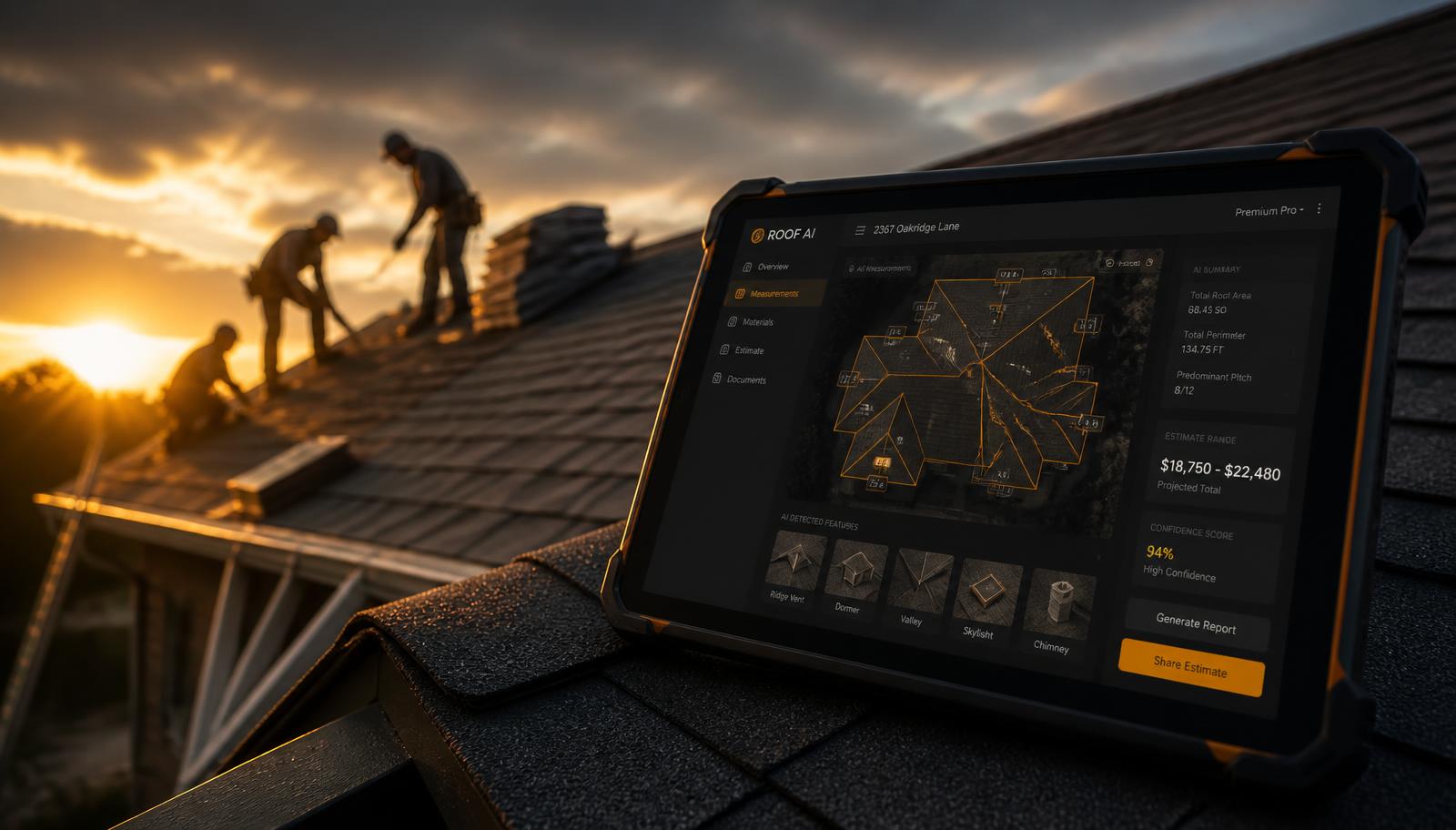
AI measurement reads aerial or drone imagery and inspection photos and returns total squares, predominant pitch, facet count, ridge, hip, valley, eave and rake lengths, plus penetrations like chimneys, skylights and vents. What used to be a return trip and an hour of takeoff becomes a few minutes while you are still in the driveway.
Treat the output as a draft that a human confirms. Imagery ages, additions get built, and tree cover hides facets. The inspector's photos and eyes reconcile the model with the actual roof before anything is priced.
- Squares, pitch, facets and linear footage generated from imagery before the inspection is even complete.
- Photo-assisted damage documentation attached to the job record for insurance and for the customer.
- Waste factor and material lists derived from facet complexity rather than a flat guess.
- Human verification step on every measurement above a dollar threshold you set.
Workflow 3: Send the bid the same day
Homeowners collect two or three roofing bids and, in practice, weight the first credible one heavily — especially after a storm, when they want the problem to stop being their problem. A proposal delivered within hours closes at roughly double the rate of the same proposal delivered four days later.
AI closes the gap by removing the typing. Measurements, photos and your inspection notes assemble into a line-itemed proposal against your own material costs, labor rates, waste factors and markup: tear-off layers, decking allowance, underlayment, ice-and-water, drip edge, ridge vent, flashing, disposal, permits, warranty terms and exclusions. Good/better/best options generate side by side so the homeowner chooses between your tiers instead of between your company and a competitor.
The pattern that works is AI drafts, owner approves. Your margin and your reputation are pricing decisions; AI should assemble the estimate, never decide what your work is worth.
- Line-itemed proposals from your own pricebook, not national averages.
- Good/better/best shingle tiers generated in one action, with financing language attached.
- Photo evidence and the measurement report embedded so the number is defensible.
- Text and email delivery with e-signature, sent from the driveway.
Same scope, same price, same crew. Sent Tuesday instead of Friday, it closes roughly twice as often.
Workflow 4: Dispatch crews around weather and capacity
A roofing schedule is a weather problem wearing a calendar's clothes. Tear-offs cannot be half-finished into a thunderstorm, dumpsters and material drops have to land ahead of the crew, and subcontracted crews have their own capacity limits.
AI dispatch sequences jobs by crew skill, tear-off capacity, drive time, material delivery windows and the forecast, then rebuilds the board when a day gets rained out instead of leaving you to re-text sixteen homeowners by hand. Customers get automatic arrival windows and delay notifications, which removes most of the inbound "are you coming?" calls.
- Crew assignment by pitch, steep-slope capability, material type and certification.
- Automatic rescheduling cascade when weather kills a day.
- Material and dumpster delivery timed ahead of crew arrival.
- Arrival-window and delay texts to homeowners without office involvement.
Workflow 5: Insurance scope and supplements
Supplements are the most under-worked profit line in residential roofing. Carriers issue a scope, the crew finds more, and in a busy month nobody writes it up — so the company eats decking, code upgrades, steep-slope charges, second-layer tear-off or detach-and-reset work it actually performed.
AI compares the carrier's scope against your measurement report, photo documentation and completed work log, and flags every line that appears in one and not the other. It drafts the supporting narrative with photo references attached, ready for a human to review and submit.
This is a strict draft-and-review workflow. Every claim position, every conversation with an adjuster, and every representation about coverage must be made by a licensed human who understands your state's rules. AI assembles evidence; it does not negotiate claims or advise homeowners on coverage.
- Line-by-line gap analysis between carrier scope and measured, documented, completed work.
- Photo evidence auto-attached to each flagged item.
- Drafted narratives a human edits and submits — never auto-filed.
- A running log of supplement dollars requested versus approved by carrier.
Most roofing companies do not have a pricing problem. They have a documentation problem, and documentation is exactly what AI is good at.
Workflow 6: Collect faster and see margin by job
Roofing runs on large tickets and lumpy cash. A single unpaid replacement can be a payroll problem. Invoices that go out on Sunday night, deductible collection that nobody chases, and insurance checks sitting in a homeowner's kitchen drawer all extend days-to-payment for no good reason.
Automate it: invoice fires on job completion with photos attached, deposit and deductible reminders go out on a schedule, insurance disbursement milestones get tracked, and overdue balances receive polite escalating follow-ups. Owners who turn this on typically pull days-to-payment down by one to two weeks without a single uncomfortable phone call.
Reporting follows the same data. Instead of a month-end guess, you get margin per job and per crew, cost of materials against estimate, backlog in squares and dollars, and lead-source performance for the storm you just chased.
- Invoice on completion with photo documentation attached.
- Deposit, deductible and progress-draw reminders on autopilot.
- Escalating collections sequence before anything becomes a phone call.
- Live margin by job and crew, backlog in squares, and lead source ROI.
What AI should never do on a roofing job
The fastest way to get burned is to let automation cross into judgment. Draw the line explicitly and put approval thresholds in the system rather than in someone's memory.
- Structural decisions — decking condition, rafter or truss concerns, load questions. Human only.
- Code and permitting interpretation, which varies by jurisdiction and changes. Human only.
- Safety calls — fall protection, weather stop-work, steep-slope staffing. Human only.
- Final pricing on complex, commercial or high-risk scope. AI drafts, owner sets the number.
- Insurance negotiation and any statement to a homeowner about coverage. Licensed human only.
- Unhappy customers, warranty disputes and leak callbacks — escalate to a person immediately.
What it costs and what it has to return
A consolidated AI platform for a roofing company generally runs $200 to $1,000 per month depending on crew count and features, against $3,500 to $5,500 per month fully loaded for a part-time to full-time office administrator. Standalone point tools — a measurement service, an answering service, a CRM, an estimating app — commonly add up to more than one platform while leaving your data in four places.
The break-even math in roofing is unusually forgiving because the tickets are large. At a $12,000 to $16,000 average replacement, one additional booked and closed job per quarter covers a year of software. Most owners find the payback in two places long before that: calls answered during a surge, and supplements they would otherwise have skipped.
Track four numbers monthly and the decision makes itself: calls answered versus offered, percentage of bids sent within 24 hours, supplement dollars recovered, and average days-to-payment.
A 30-day rollout that survives storm season
Do not deploy everything the week a hailstorm hits. Add one workflow per week during a normal stretch so each is proven before the surge tests it.
Week 1 — intake. Forward after-hours and overflow calls to the AI receptionist, set triage and escalation rules, review every booked inspection for accuracy. Measure calls answered against last month.
Week 2 — measurement and estimating. Run your next five inspections through AI measurement, load your pricebook, and send good/better/best proposals from the driveway. Track the percentage sent within 24 hours.
Week 3 — invoicing, collections and follow-up. Turn on invoice-on-completion, deposit and deductible reminders, and automatic proposal nudges at day 3 and day 7. Watch days-to-payment and recovered bids.
Week 4 — dispatch, supplements and reporting. Move the schedule onto the board with weather-aware rescheduling, switch on supplement gap analysis, and start reading margin by crew weekly.
- Week 1: 24/7 call answering, triage and inspection booking.
- Week 2: AI roof measurement and same-day tiered proposals.
- Week 3: automatic invoicing, collections and proposal follow-up.
- Week 4: weather-aware dispatch, supplement gap analysis, live margin reporting.
One workflow a week. By day 30 the office runs itself and the next storm becomes a capacity question instead of a chaos question.
How ContractorPro.io runs a roofing company
ContractorPro.io is an AI operating system built for contractors, including roofing companies — 22 AI employees working one shared record instead of six disconnected apps. Reception answers the storm surge and books inspections. Estimating turns measurements, photos and notes into tiered proposals off your pricebook. Scheduling sequences tear-offs around crews, materials and weather. Accounting invoices on completion and chases the deductible. Business Intelligence reports margin by job and crew while the crew is still on the roof.
Everything runs in approval-only mode by default: the AI drafts, you approve with one click, and you widen its permissions capability by capability as it earns trust. Your data stays in your workspace, encrypted in transit and at rest, and is never used to train shared models.
Plans start at $199/month with a 3-day free trial, no setup fees and cancel anytime. Setup is self-serve — start with intake and same-day proposals, and let the next storm pay for the rest.
- 24/7 AI reception that triages leaks, storm damage and quote requests, and books to the live board.
- Same-day tiered proposals from your own material and labor pricing.
- Weather-aware crew dispatch with automatic homeowner arrival texts.
- Invoice-on-completion, deductible reminders and escalating collections.
- Live margin by job and crew, backlog in dollars, and lead-source ROI.
One platform, one record, 22 AI employees — priced below a part-time office hire.
Frequently asked questions
How do roofing companies use AI in 2026?
Primarily in the office and sales cycle: answering and triaging storm calls 24/7, booking inspections, measuring roofs from aerial imagery and inspection photos, assembling same-day line-itemed proposals from the company's own pricebook, dispatching crews around weather and capacity, drafting insurance supplement documentation for human review, invoicing on completion, chasing deductibles and reporting live margin by job and crew. AI does not perform roofing work or make structural, code, safety or claim decisions.
Can AI accurately measure a roof?
AI measurement from aerial, drone or photo imagery reliably produces squares, predominant pitch, facet count and ridge, hip, valley, eave and rake lengths for most residential roofs in minutes. Accuracy degrades with stale imagery, heavy tree cover, recent additions and complex commercial assemblies, so the correct workflow is AI generates the measurement and the inspector verifies it against photos and the physical roof before anything is priced.
Is AI worth it for a small roofing company with one or two crews?
Usually yes, because a small roofing company has no office staff to absorb a storm surge. At $200 to $1,000 per month against a $12,000 to $16,000 average replacement ticket, the system needs roughly one extra closed job per quarter to pay for a full year. Owner-operators who miss calls while on a roof typically see payback from call answering alone within the first month.
Will an AI receptionist hurt trust with homeowners?
Not if it is configured properly. Homeowners with an active leak strongly prefer a competent immediate answer to voicemail. A good setup answers in one ring using your company name, asks the questions your office would ask, hands true emergencies to a human phone right away, and books a real inspection slot. Review transcripts for the first two weeks and tune the script until it sounds like your business.
Can AI help with roofing insurance supplements?
Yes, as a documentation tool. AI compares the carrier's scope against your measurement report, photos and completed work log, flags line items that were performed but not paid, and drafts supporting narratives with evidence attached. A licensed human must review, submit and negotiate every claim position — AI should never file a supplement or advise a homeowner about coverage.
What should a roofing company automate first?
Call intake and proposal follow-up. Missed storm calls are the largest silent revenue leak in roofing and unaccepted proposals are the cheapest revenue to recover, so those two usually cover the entire cost of the system within the first month. Add measurement and estimating next, then invoicing and collections, then dispatch and supplements.
How fast can a roofing company see results from AI?
Call answering shows countable results within days. Proposal speed shows within two to three weeks as close rates on same-day bids come in. Collections improvements appear over one full billing cycle, usually 30 to 45 days. Supplement recovery and margin reporting become meaningful after about a month of clean job data.
Does AI replace roofing crews or estimators?
No. It replaces the repetitive office work around them — answering, booking, takeoff data entry, typing proposals, sending invoices, chasing payment and assembling documentation. Crews still install the roof and estimators still own pricing judgment, scope decisions and customer conversations. Most roofing companies use AI to delay an office hire or to move an existing estimator onto more inspections per week.
Sources & further reading
Primary references from government agencies, standards bodies and platform documentation used to fact-check this guide.
- OSHA — Construction industry safety and health standards (29 CFR 1926)U.S. Occupational Safety and Health Administration
- International Building and Residential CodesInternational Code Council
- Construction Spending (Value of Construction Put in Place)U.S. Census Bureau
Run your whole contracting business with an AI team
One platform replaces the dispatcher, estimator, scheduler, bookkeeper and follow-up coordinator — so the crew builds while the AI team handles the office. Start a free trial and your AI employees go to work on day one.
AI answering service
Every call answered instantly and booked on your calendar — no missed jobs after hours.
Instant estimates & quotes
Turn a few project details into a branded estimate in seconds, then send it by text and email.
Smart scheduling & crews
Auto-assign jobs to the right crew, send reminders, and keep the week full without double-booking.
Invoicing & payments
Generate invoices, take payment by card or ACH, and sync revenue into live financial dashboards.
Live CRM & follow-up
Track every lead and customer, with automated follow-up that wins more repeat business.
Real-time business insights
KPIs for revenue, margin, backlog and cash flow — updated as work happens, not at month-end.
3-day free trial · Cancel anytime
Keep reading

Business Growth
How to Run a $1 Million Construction Business With Just 3 Employees
Read
General Contractors
ContractorPro AI for General Contractors: The Complete Guide to Estimating, Subcontractors, Scheduling, Job Costing and Getting Paid
Read
HVAC Contractors
ContractorPro AI for HVAC Companies: The Complete Guide to Leads, Dispatch, Estimating, Service Agreements and Getting Paid
Read