AI for Landscaping Contractors in 2026: The Complete Owner's Guide
Landscaping runs on volume: dozens of small tickets a day, seasonal swings, route density, and renewals that decide whether next year is profitable. Here is exactly where AI helps a landscaping or lawn care company in 2026 — intake, estimating, routing, crew dispatch, renewals and collections — what it costs, what it must never touch, and a 30-day rollout that survives spring rush.
By ContractorPro Editorial Team
Why landscaping is a volume problem, not a job problem
A roofer wins or loses on a handful of five-figure jobs. A landscaping company wins or loses on hundreds of small ones. A maintenance route might be 18 stops at $65, a mulch job $1,400, an install $22,000 — and the office has to touch every one of them with a quote, a schedule slot, a crew, an invoice and a follow-up.
That is why landscaping owners burn out on admin faster than almost any trade. The work itself is straightforward; the coordination is relentless. And it is seasonal, so the volume triples for eight weeks and then collapses, which makes hiring a full-time office administrator awkward and expensive.
Everything in that coordination layer is phone calls, text, scheduling math and paperwork — the exact category current AI handles well. It will not tell you why a hydrangea is failing or whether that maple needs to come down. It will answer sixty calls on the first warm Saturday, sequence tomorrow's route by drive time, and chase forty unpaid invoices without being asked twice.
In landscaping, the office is the bottleneck long before the crews are. AI is the cheapest way to widen it seasonally.
Workflow 1: Answer every spring-rush call and text
The first genuinely warm weekend of the year generates more inbound volume than any other week. Most of it hits voicemail, and most of those homeowners simply dial the next landscaper on the list. Missed calls in a maintenance business are not one lost job — they are a lost annual contract plus every cleanup, mulch and aeration add-on attached to it.
An AI receptionist answers on the first ring, on every line simultaneously, by phone or text. It asks the questions your best office person asks: property address, lot size, is this weekly maintenance or a one-time job, is it design-build, irrigation, hardscape or tree work, and when are they home for a walkthrough. It books the estimate slot against real crew and route availability, then confirms by text.
- Work-type triage you define: recurring maintenance, seasonal cleanup, mulch and beds, irrigation service, hardscape, design-build, or out of service area.
- Simultaneous call handling — a warm Saturday does not queue behind one person with a cell phone.
- Address captured up front so route fit is checked before the appointment is booked.
- Text-first follow-up, which most residential landscaping customers prefer over a callback.
- After-hours behavior you control: book it, capture and confirm at 7am, or escalate an irrigation flood to a human immediately.
One recovered maintenance contract at $2,600 a year, renewed for three years, pays for the entire software stack.
Workflow 2: Quote the property the same day
Landscaping estimating is measurement plus a pricebook, and both are automatable. AI reads aerial imagery to return lot area, turf square footage, bed and hardscape area, driveway and walkway linear footage, and tree canopy coverage — enough to price a mow route, a mulch job, a cleanup or an aeration in minutes rather than after a site visit.
Those measurements flow into your own pricing: your production rates, your crew cost per hour, your mulch cost per yard, your margin targets. The output is a line-itemed proposal a homeowner can accept from a phone, with the recurring-service option priced alongside the one-time job so the upsell is present at the moment of decision.
Complex installs still need a human. Grading, drainage, plant selection and hardscape structure are judgment and liability calls. Use AI for the takeoff and the document, not for the design decision.
- Turf, bed, hardscape and canopy measurements from imagery before anyone drives out.
- Line items priced off your own pricebook and production rates, not a generic market average.
- Recurring maintenance presented alongside the one-time job on every quote.
- Good-better-best options — basic mow, full-service, and full-service with fertilization — generated automatically.
- Accept-and-schedule in one step, so a signed quote lands directly on the route.
Workflow 3: Route density is the whole margin
The difference between a profitable landscaping company and a busy one is usually windshield time. Fourteen stops a day with 90 minutes of driving beats eleven stops with three hours of driving, on the same payroll and the same fuel.
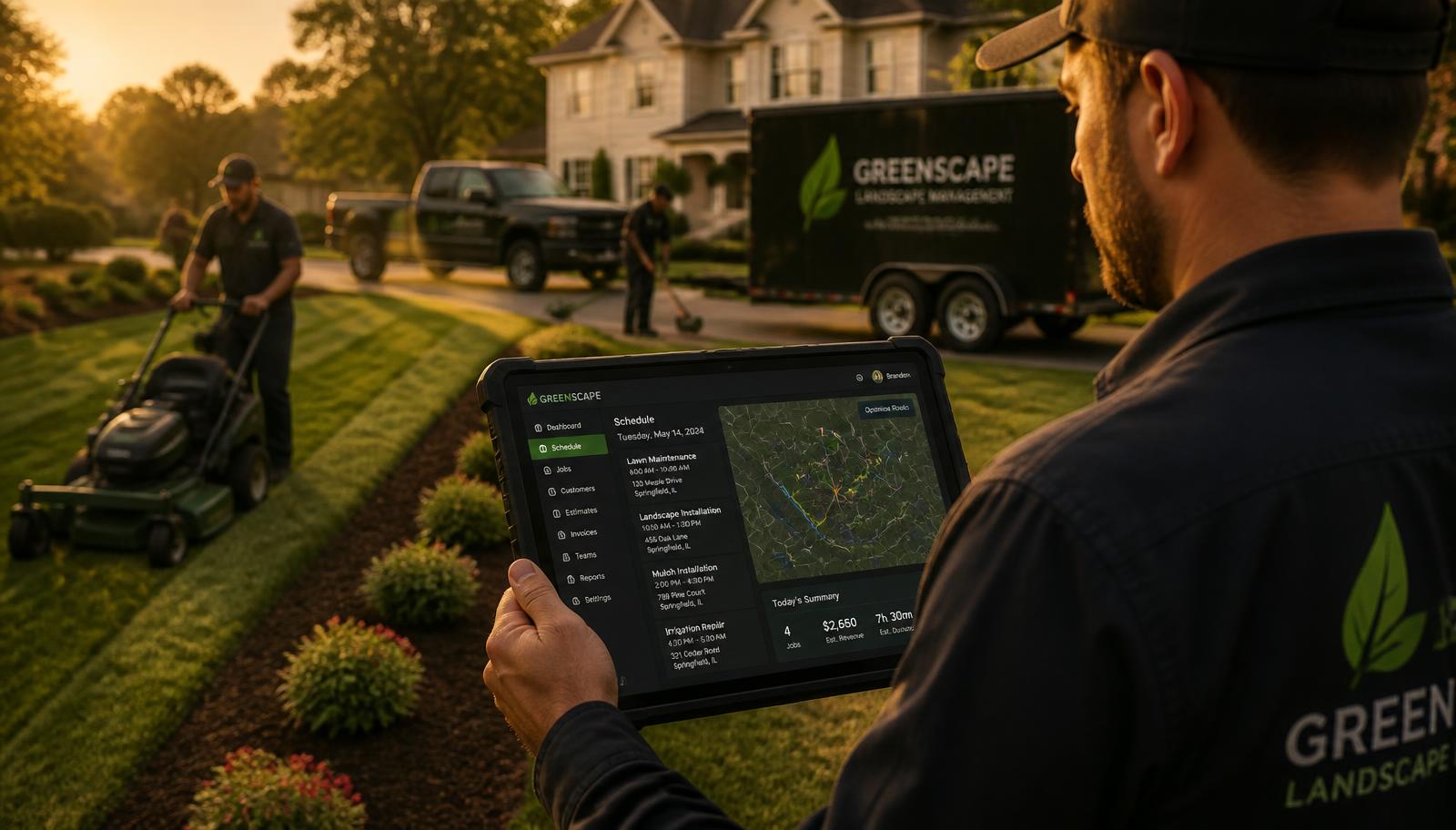
AI scheduling sequences jobs by geography, time window, crew skill, equipment already on the trailer, and realistic drive time between stops. When a new customer books mid-week, it slots them where they add the least drive time instead of wherever the calendar happens to look empty. When a job runs long, the rest of the route re-sequences and the affected customers get an updated arrival text automatically.
- Route sequencing by drive time, not by the order jobs were entered.
- New bookings placed into existing route density rather than creating a new detour.
- Crew-skill matching: irrigation techs on irrigation calls, install crews on installs.
- Automatic customer arrival windows and on-the-way texts, which cut callbacks to the office.
- Live job costing per stop — actual crew hours against quoted hours, visible the same day.
Adding two stops per truck per day across four trucks in a 30-week season is a six-figure revenue swing with zero new headcount.
Workflow 4: Turning rain days into rescheduled days
Weather is the tax every landscaping company pays. A rained-out Tuesday used to mean a dozen phone calls, a hand-rebuilt Wednesday, and three customers who never got told.
AI handles the mechanical part: it pulls the affected stops, proposes a reschedule that respects route density and existing commitments, notifies every customer by text with the new window, and flags the jobs that genuinely cannot slip — the closing-day cleanup, the HOA inspection, the install with a delivery already scheduled.
You still make the call on whether to run. The system just removes the two hours of phone work that follow the decision.
- Affected stops identified and grouped automatically when a day is called.
- Reschedule proposals that preserve route efficiency instead of scattering makeup work.
- Bulk customer notification by text with the new arrival window.
- Hard-deadline jobs flagged so they get priority in the makeup route.
Workflow 5: Renewals, seasonal upsells and the off-season
Most landscaping companies leave more money in their existing customer list than they chase in new leads. A customer who bought weekly mowing last year is a candidate for spring cleanup, mulch, aeration and overseeding, fall leaf removal, irrigation blowout and holiday lighting — and almost nobody asks systematically.
AI reads last year's service history and drafts the campaigns: renewal offers timed before the season, cleanup offers to the customers who bought one last March, aeration to the lawns that did not get it, blowout reminders to every irrigation customer in October. You approve the list and the message; the sends and follow-ups run themselves.
This is also how the off-season stops being dead. Snow, holiday lighting and pre-booked spring contracts all get sold in the quiet months by a system that does not need a warm week to remember to email.
- Renewal campaigns generated from last season's contract list, with pricing adjustments applied.
- Service-gap upsells: customers who bought mowing but never bought aeration, mulch or fertilization.
- Seasonal timing rules so blowout reminders and cleanup offers land in the right week.
- Review requests sent automatically after a completed job, which compounds local search visibility.
Workflow 6: Get paid without chasing
High-volume, low-ticket work is where receivables quietly rot. Nobody wants to spend Friday afternoon chasing eleven $65 invoices, so they age, and by August the company is financing its customers.
The fix is mechanical: invoice automatically the moment a crew marks the stop complete, keep a card on file for recurring maintenance with autopay, and let the system send the reminder sequence on anything that ages past terms. Escalate only the accounts that genuinely need a human conversation.
- Invoice generated at job completion from the crew's mobile check-off, not from a Sunday paperwork session.
- Card on file and autopay for recurring maintenance customers.
- Automatic reminder sequence at 7, 14 and 30 days past due.
- A/R aging by customer and by crew, so the owner sees the problem in June instead of September.
Cutting average days-to-payment from 41 to 12 on a $1.2M book frees roughly $95,000 of working capital.
What AI should never do in a landscaping business
The fastest way to lose trust in these tools is to point them at decisions they are not qualified to make. Draw the line clearly and tell your crews where it is.
- Horticultural diagnosis — plant disease, pest identification and treatment plans belong to a qualified human.
- Chemical and pesticide applications — licensing, rates, restricted-use products and record-keeping are regulated and human-owned.
- Tree risk assessment and removal decisions — an arborist's call, never a model's.
- Drainage, grading and retaining wall structure — engineering judgment with real liability attached.
- Final pricing on complex design-build work, and any contract term or change order.
- Anything a customer would be upset to learn was decided by software rather than by a person.
What it costs and what it replaces
A consolidated AI-enabled platform for a landscaping company typically runs a few hundred dollars a month, scaling with crew count. Compare that against the alternatives rather than against zero.
A full-time office administrator runs roughly $3,500–$5,500 per month loaded, and a seasonal business struggles to keep one busy in January. A separate answering service is $200–$600 per month and cannot book against your route. Standalone estimating, CRM, routing and invoicing tools stack to $400–$900 per month and none of them talk to each other, so someone re-keys everything.
The realistic math for a four-crew company: recover two missed contracts per month, add two stops per truck per day, and cut 25 days off average payment time. Any one of those pays for the software; together they change the year.
- Consolidated platform: roughly $200–$1,000/month depending on crews and features.
- Office administrator: $3,500–$5,500/month loaded, year-round, for seasonal demand.
- Point tools stacked together: $400–$900/month plus the re-keying labor between them.
- Cost of the status quo: missed spring calls, Thursday quotes, half-empty routes and 45-day receivables.
A 30-day rollout that survives spring
Do not switch everything on at once, and do not start during your busiest week. One workflow per week, with a measured before-and-after, is how this sticks.
- Week 1 — Intake. Turn on AI call and text answering for overflow and after-hours only. Measure calls answered and walkthroughs booked against last month.
- Week 2 — Estimating. Load your real pricebook and production rates. Send every quote the same day. Measure time-to-quote and close rate.
- Week 3 — Scheduling and routing. Move one crew's route onto AI sequencing. Measure stops per day and drive time versus the manual route.
- Week 4 — Invoicing and renewals. Invoice at job completion, put maintenance customers on card-on-file autopay, and send one seasonal upsell campaign to last year's list.
- Day 30 — Review the five numbers: calls answered, quotes sent within 24 hours, stops per truck per day, days-to-payment, and owner hours spent on admin.
Frequently asked questions
Can AI actually estimate a landscaping job accurately?
For measurable, repeatable work — mowing, mulch, cleanups, aeration, edging, leaf removal — yes. AI measures turf, bed and hardscape area from aerial imagery and prices it against your own pricebook and production rates, which is more consistent than a rushed manual takeoff. For design-build, grading, drainage and hardscape structure, treat the AI output as a takeoff draft and have a human price the job.
Will an AI receptionist annoy residential landscaping customers?
Less than voicemail does. Modern voice AI answers on the first ring, speaks naturally, and books the appointment on the spot. Configure it to identify itself as an assistant and to hand off to a human on request — customers overwhelmingly prefer an immediate answer and a confirmed time over a callback that may come tomorrow.
Does AI routing really add stops per day?
Routing by drive time and geography rather than by booking order typically recovers 30–90 minutes of windshield time per truck per day for residential maintenance routes. Whether that becomes one extra stop or three depends on your service density. The gain is largest for companies with tight suburban routes and smallest for rural work with long unavoidable drives.
What about chemical applications and licensing?
AI can schedule the visit, remind the customer, generate the invoice and store the application record you enter. It should not select products, set rates, or make treatment decisions. Those are licensed activities with state-specific record-keeping requirements, and a human applicator owns them.
Is this worth it for a two-crew landscaping company?
Usually yes, because a two-crew company has no office staff at all — the owner is the office, at night. The value shows up as recovered evenings and same-day quotes rather than as headcount savings. Start with intake and estimating only; add routing when you run a third crew.
How does ContractorPro handle seasonal swings?
ContractorPro's AI team scales with call and job volume rather than with hiring, so spring rush and January quiet cost the same in staffing terms. Renewal and upsell campaigns are designed to run during the off-season, when there is time to sell next year's contracts.
Sources & further reading
Primary references from government agencies, standards bodies and platform documentation used to fact-check this guide.
- Arborist certification and tree care standardsInternational Society of Arboriculture
- Construction occupations: employment, pay and outlookU.S. Bureau of Labor Statistics
- OSHA — Construction industry safety and health standards (29 CFR 1926)U.S. Occupational Safety and Health Administration
Run your whole contracting business with an AI team
One platform replaces the dispatcher, estimator, scheduler, bookkeeper and follow-up coordinator — so the crew builds while the AI team handles the office. Start a free trial and your AI employees go to work on day one.
AI answering service
Every call answered instantly and booked on your calendar — no missed jobs after hours.
Instant estimates & quotes
Turn a few project details into a branded estimate in seconds, then send it by text and email.
Smart scheduling & crews
Auto-assign jobs to the right crew, send reminders, and keep the week full without double-booking.
Invoicing & payments
Generate invoices, take payment by card or ACH, and sync revenue into live financial dashboards.
Live CRM & follow-up
Track every lead and customer, with automated follow-up that wins more repeat business.
Real-time business insights
KPIs for revenue, margin, backlog and cash flow — updated as work happens, not at month-end.
3-day free trial · Cancel anytime
Keep reading

Business Growth
How to Run a $1 Million Construction Business With Just 3 Employees
Read
General Contractors
ContractorPro AI for General Contractors: The Complete Guide to Estimating, Subcontractors, Scheduling, Job Costing and Getting Paid
Read
HVAC Contractors
ContractorPro AI for HVAC Companies: The Complete Guide to Leads, Dispatch, Estimating, Service Agreements and Getting Paid
Read