AI for Electricians: How an AI Team Runs an Electrical Business in 2026
AI for electricians is not a chatbot on your website. It is a set of software workers with job descriptions and permissions — answering service calls, dispatching the right licensed hand, drafting priced quotes off your material list, and chasing retainage. Here is what each one does, what it costs, where it must never be trusted, and how to roll it out in 30 days.
By ContractorPro Editorial Team
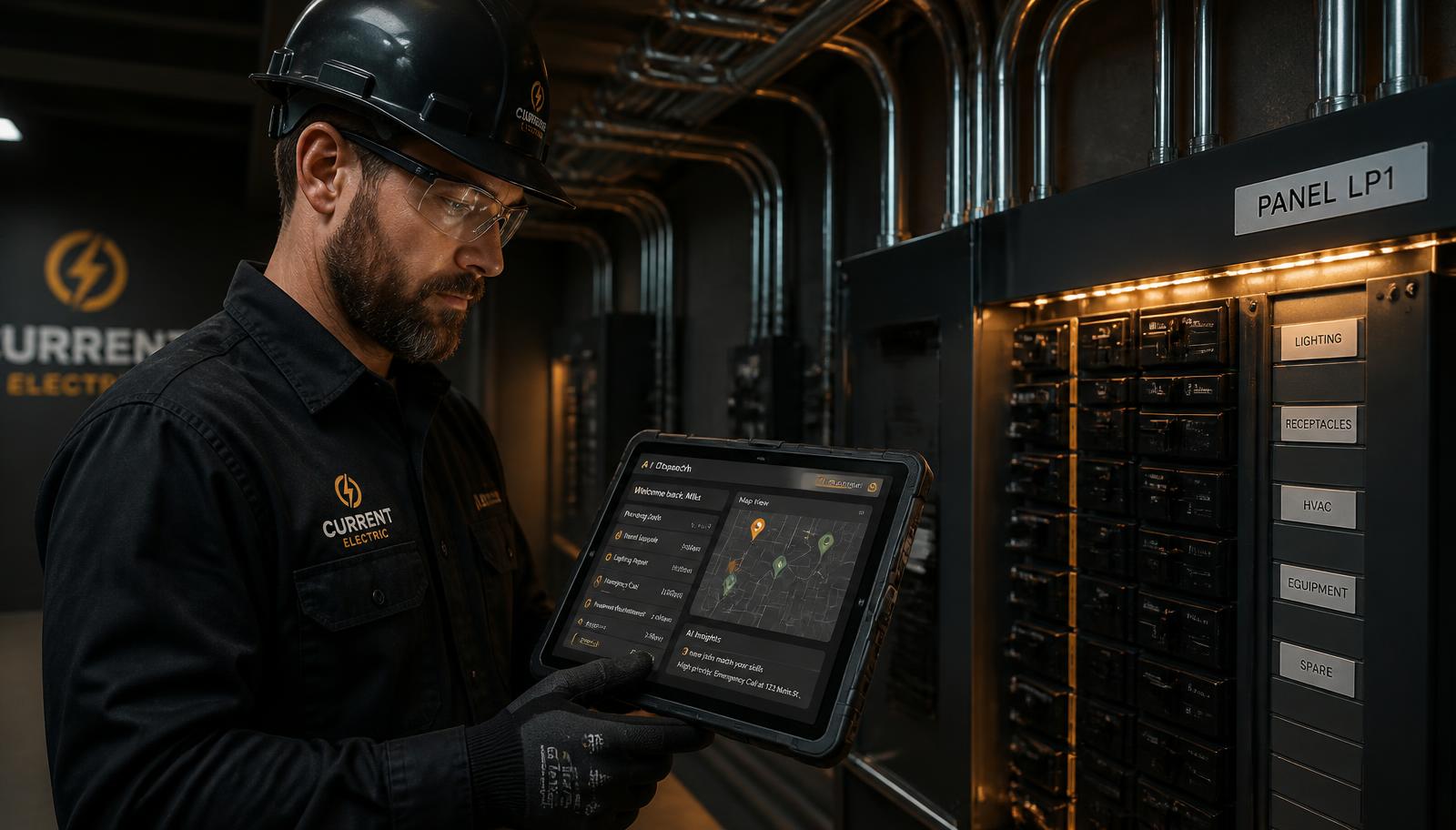
What does AI for electricians actually mean?
For an electrical contractor, AI is best understood as staff you do not have to hire. Each agent is assigned one seat in the business — the phone, the board, the estimate, the invoice, the compliance binder — and given access to the same records a person in that seat would use. It takes an action, logs it, and escalates anything outside its rules.
That is a different product from the generic assistants most owners have tried. A general chatbot can write a customer email. It cannot see that Tuesday's panel-change job needs a journeyman with a lift certification, that the material for it was picked up Friday, and that the customer still owes $4,200 on the last phase. Agents that read your job, customer and pricing data can.
The practical test is simple. Ask what records the tool can read and what actions it is allowed to write. If the honest answer is 'none, it just talks', it is marketing software, not an AI team.
If it cannot read your work orders and write to your schedule, it is a website widget — not an employee.
The seven agents that matter in an electrical shop
Most electrical contractors do not need twenty agents. They need five to seven roles covered reliably, in the order that money leaks out of the business.
- Call and intake agent — answers every inbound service call and web form, qualifies the fault (no power, tripping breaker, panel upgrade, EV charger install), captures address and access notes, and books into a real slot rather than promising 'someone will call back'.
- Dispatch agent — assigns the job to a hand with the right licence level and truck stock, sequences the day by drive time, and reshuffles automatically when a service call goes long or a permit inspection slips.
- Estimating agent — drafts priced quotes from your material list and historical labour units for repeatable scopes: service upgrades, panel replacements, EV charger installs, lighting retrofits, generator hookups. The electrician reviews and signs.
- Project agent — tracks phases, rough-in and trim milestones, submittals and change orders on construction work, and flags when actual hours pull ahead of the estimated units.
- Invoicing and collections agent — turns completed work orders into invoices the same day, applies deposits and progress billing, and chases 30/60/90 balances and retainage on a schedule instead of when someone remembers.
- Compliance agent — watches licence renewals, apprentice ratios, certificates of insurance, permit status and inspection dates, and warns before something expires rather than after a jobsite is shut down.
- Customer follow-up agent — sends arrival notices, post-job summaries with photos, review requests, and service-agreement or infrared-scan renewal reminders.
Where AI saves the most money in electrical work
Electrical contracting has three characteristic leaks, and AI addresses each differently.
The first is missed demand. Service calls do not respect business hours, and a large share arrive when the office is closed. An agent that answers, qualifies and books at 9pm converts calls that previously went to voicemail. This is the fastest measurable change in nearly every shop.
The second is quote latency. On residential service upgrades and EV charger installs, the contractor who sends a clear priced quote first usually wins. When quoting depends on an owner finding an evening to sit down with a spreadsheet, quotes go out in days. Draft-in-minutes with human approval collapses that window.
The third is cash timing. Electrical work carries deposits, progress billing and retainage, and every one of those is a chance for money to sit unbilled. An agent that invoices on completion and chases aging balances on a fixed cadence usually moves days sales outstanding more than any pricing change.
Service work versus construction work
The two sides of an electrical business reward different agents, and rolling out the wrong one first is the most common way an owner concludes 'AI does not work for us'.
A service-heavy shop lives on call capture, dispatch efficiency and same-day invoicing. Start there and the payback is visible inside a month.
A construction or tenant-improvement contractor lives on takeoff speed, submittals, change order documentation and retainage recovery. The call agent will not move the needle; the estimating and project agents will. Mixed shops should sequence by whichever side produces more revenue this quarter, not by whichever demo looked more impressive.
What AI must never do on an electrical job
This is the part most vendor material skips, and it is the part that protects your licence.
- No code interpretation. AI does not decide whether a scope complies with the NEC or your local amendments. A licensed human does.
- No conductor, service or overcurrent sizing as a final answer. Treat any calculation output as a draft to be verified, never as a specification to install from.
- No permit or inspection judgement. AI can track dates and paperwork; it cannot decide a permit is unnecessary or that an inspection passed.
- No final pricing on unseen conditions. Old wiring, hidden junctions, aluminium branch circuits and inaccessible panels are found by people, not by models.
- No safety calls. Energised work decisions, lockout/tagout and arc-flash boundaries are human territory, full stop.
- No unsupervised customer commitments. Anything that changes price, scope or warranty should sit in a draft-and-approve queue.
Automate the paperwork around the licence. Never automate the judgement behind it.
What an AI team costs an electrical contractor
There are two pricing shapes in the market in 2026. Traditional field service platforms charge per user per month, commonly $50–$500 per seat, and sell AI features as add-ons — so cost rises every time you hire. AI operating systems charge a flat monthly platform fee, commonly $199–$999, because the agents are the capacity rather than the seats.
The comparison that matters is not software versus software. It is software versus the office hire you are about to make. A part-time office coordinator or answering service handling after-hours calls, invoicing and follow-up is a meaningful monthly cost with holidays, turnover and training attached. An agent covering the same tasks does not call in sick during storm season.
Run the number on your own inputs rather than a vendor's. Multiply your missed after-hours calls per month by your typical service-call revenue and close rate, then compare against the platform fee. Most shops find the call agent alone justifies the whole platform.
A 30-day rollout plan
Deploy in phases and measure one thing per phase. Trying to switch on seven agents in week one is how implementations stall.
- Days 1–7 — Load your customer list, service history and price/material list. Turn on the call and intake agent for after-hours only. Metric: percentage of after-hours calls answered and booked.
- Days 8–14 — Turn on dispatch drafting, with the coordinator approving the board each morning. Metric: average drive time per completed call.
- Days 15–21 — Turn on estimating for your three most repeatable scopes only, in draft-and-approve mode. Metric: hours from site visit to quote sent.
- Days 22–30 — Turn on same-day invoicing and the aging-balance chase. Metric: days sales outstanding versus the prior 90-day average.
- Ongoing — Add the compliance and follow-up agents once the first four are trusted. Review the action log weekly and tighten any rule that produced an escalation you disagreed with.
How to evaluate an AI tool before you buy
Ask vendors these questions and the field narrows quickly.
- Which of my records can each agent read, and which can it write to? Vague answers mean a chat wrapper.
- Is there an action log showing what the AI did, when, and on whose authority — and can I reverse it?
- What sits behind an approval gate by default, and can I move the gates myself?
- Does pricing rise when I add electricians? A per-seat model taxes growth.
- What happens to my data if I leave, and can I export customers, jobs and invoices in full?
- Can I start with one agent instead of committing to the whole suite on day one?
Frequently asked questions
Can AI replace an electrician?
No. AI cannot pull wire, terminate a panel, diagnose a fault in the field, or make a code judgement. What it replaces is the unpaid office work around the trade — answering and booking calls, building the daily board, drafting quotes, invoicing and chasing money. The licensed work stays with licensed people.
What is the best AI tool for electricians to start with?
For service-led shops, the call and intake agent. Service calls arrive outside office hours and the first contractor to answer usually gets the job, so 24/7 answering and booking produces measurable revenue within weeks. For construction-led contractors, start with the estimating agent instead, because quote turnaround and takeoff speed drive that side of the business.
How much does AI software for electrical contractors cost?
Expect $199–$999 per month for a flat-rate AI operating system that includes the agents, or $50–$500 per user per month for a traditional field service platform with AI features added on. Per-seat pricing costs more as you hire; flat-rate pricing does not.
Can AI do electrical estimates?
It can draft them. An estimating agent assembles a priced quote from your own material list and historical labour units for repeatable scopes such as service upgrades, panel swaps, EV charger installs and lighting retrofits. A licensed estimator must review and approve before it goes out, because site conditions and code requirements are not visible to software.
Is it safe to let AI answer customer calls for an electrical company?
Yes, within limits. An intake agent should qualify the fault, capture the address and access details, book a slot and escalate anything urgent or unusual to a human immediately. It should never quote a repair price sight-unseen, advise a customer on electrical safety, or tell someone it is fine to re-energise a circuit.
What is an AI team for an electrical business?
An AI team is several agents sharing one data model instead of separate disconnected tools. The call agent's booking becomes the dispatch agent's job, the field work order becomes the invoicing agent's invoice, and the compliance agent watches the permits attached to the same record — no re-keying and no integration gaps between them.
Sources & further reading
Primary references from government agencies, standards bodies and platform documentation used to fact-check this guide.
- NFPA 70 — National Electrical CodeNational Fire Protection Association
- OSHA — Construction industry safety and health standards (29 CFR 1926)U.S. Occupational Safety and Health Administration
- Construction occupations: employment, pay and outlookU.S. Bureau of Labor Statistics
Run your whole contracting business with an AI team
One platform replaces the dispatcher, estimator, scheduler, bookkeeper and follow-up coordinator — so the crew builds while the AI team handles the office. Start a free trial and your AI employees go to work on day one.
AI answering service
Every call answered instantly and booked on your calendar — no missed jobs after hours.
Instant estimates & quotes
Turn a few project details into a branded estimate in seconds, then send it by text and email.
Smart scheduling & crews
Auto-assign jobs to the right crew, send reminders, and keep the week full without double-booking.
Invoicing & payments
Generate invoices, take payment by card or ACH, and sync revenue into live financial dashboards.
Live CRM & follow-up
Track every lead and customer, with automated follow-up that wins more repeat business.
Real-time business insights
KPIs for revenue, margin, backlog and cash flow — updated as work happens, not at month-end.
3-day free trial · Cancel anytime
Keep reading

Business Growth
How to Run a $1 Million Construction Business With Just 3 Employees
Read
General Contractors
ContractorPro AI for General Contractors: The Complete Guide to Estimating, Subcontractors, Scheduling, Job Costing and Getting Paid
Read
HVAC Contractors
ContractorPro AI for HVAC Companies: The Complete Guide to Leads, Dispatch, Estimating, Service Agreements and Getting Paid
Read